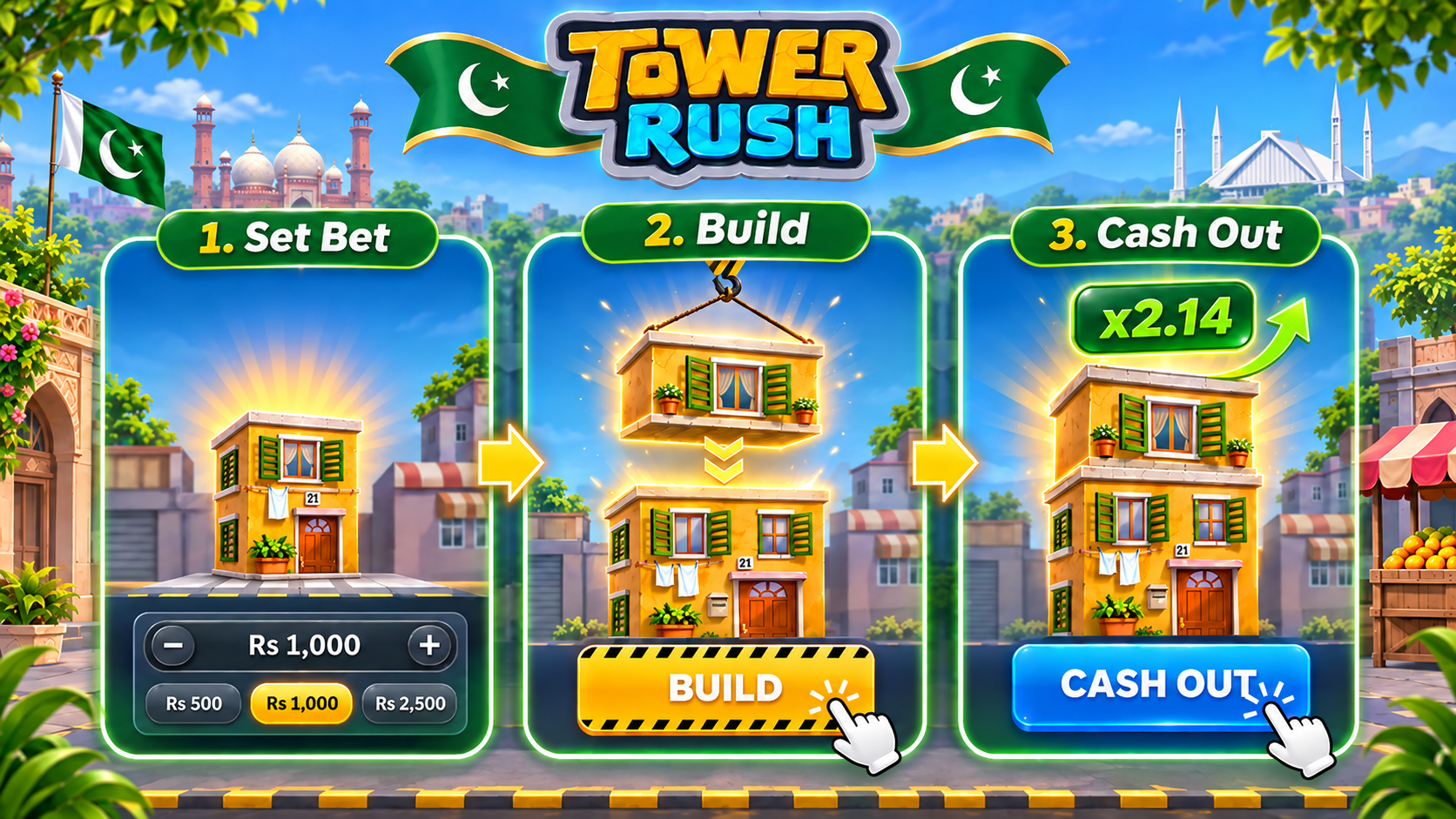
Full rules for Tower Rush by Galaxsys: how building and cash-out work, what the three bonus floors do, and a step-by-step guide to your first round.
Tower Rush swaps the usual crash-game curve for a physical stack of floors: a crane lowers one floor at a time, a clean landing multiplies your bet, and after every floor you decide whether to cash out or build higher. This page walks through the full rules from your first bet in Pakistan to your first cash-out.
₨112
Minimum bet
₨112,000
Maximum bet
3
Random bonus floors
Step by Step
Set your bet size before the round starts, from ₨112 up to ₨112000.
Press Build - the crane lowers the first floor, and a successful landing multiplies your bet.
After each floor, choose Cash Out to bank the current multiplier, or Build again to stack another floor.
Watch for Frozen Floor, Temple Floor and Triple Build - each changes the round when it appears.
A missed floor ends the round and the tower collapses, so any multiplier not already cashed out (or frozen) is lost.
That five-step loop repeats every round, and it's genuinely the entire ruleset - there's no hidden mechanic beyond it. What makes Tower Rush feel different from a plain crash curve is that the "stop or continue" decision happens visibly, floor by floor, rather than watching one continuous number climb. Each press of Build is its own small bet on the next floor landing cleanly.
Common Mistakes New Players Make
Not deciding a target before the round starts: deciding mid-climb, after the multiplier already looks tempting, tends to push people one floor past where they meant to stop.
Treating a Frozen Floor as a reason to push further than planned: it protects what's already banked, but doesn't change the odds of the next floor landing.
Betting the maximum early in a session: starting small and learning the pacing of a session matters more than any single round's size.
The Three Bonus Floors
Frozen Floor
Guaranteed insurance
Locks in your current winnings even if the tower collapses later.
Temple Floor
Bonus Temple wheel
Spins a wheel worth x1.5 up to x7 on your current multiplier.
Triple Build
Three floors at once
Drops three floors in a single move, each worth at least x1.
Try it yourself
The free demo uses the exact same rules - no deposit needed to practise.
Reading the Risk as You Climb
Stage of the climb
What tends to happen
Risk level
First few floors
Small, steady multiplier gains
Low
Mid-tower
Multiplier growth speeds up
Medium
High floors
Large multipliers, one miss away from zero
High
Bonus floor triggers
Frozen Floor, Temple Floor or Triple Build appears
Varies
Illustrative multiplier growth by floor
Floor 1-2Early, low-risk climb
~1.2x-1.5x
Floor 3-4Steady acceleration
~1.8x-2.5x
Floor 5-6Growth speeds up
~3.5x-6x
Floor 7-8High risk, high reward
~8x-15x
Floor 9+Rare, bonus-assisted runs
20x-40,000x
Illustrative pattern only, built from the published RTP/volatility range - not exact per-round odds.
Frequently Asked Questions
What happens if a floor misses?
The round ends immediately and the tower collapses - the bet is lost, with no partial payout unless a Frozen Floor already locked one in earlier in that same round.
Can I set an automatic cash-out?
Many operators let you set a target multiplier in advance, so the game cashes out automatically the moment the tower reaches it, without you needing to watch every floor land.
Do all three bonus floors appear every round?
No - Frozen Floor, Temple Floor and Triple Build are random events that can appear as you climb. None of them is guaranteed in any given round.
What's the minimum and maximum bet per round?
Most operators carrying Tower Rush set the range around ₨112 to ₨112000 per round, though exact limits can vary slightly by operator.
Does the crane ever skip a floor or do anything other than land or miss?
No - every floor resolves to one of two outcomes, a clean landing (multiplier applied) or a miss (round over). There's no partial-landing state outside of what a Frozen Floor already protected earlier in the same round.
Play within your limits. Each floor's outcome is independent and random - no cash-out pattern changes the underlying house edge. Set a deposit and time limit before you start, and treat losses as final rather than something to chase. 18+.